

Quick answer
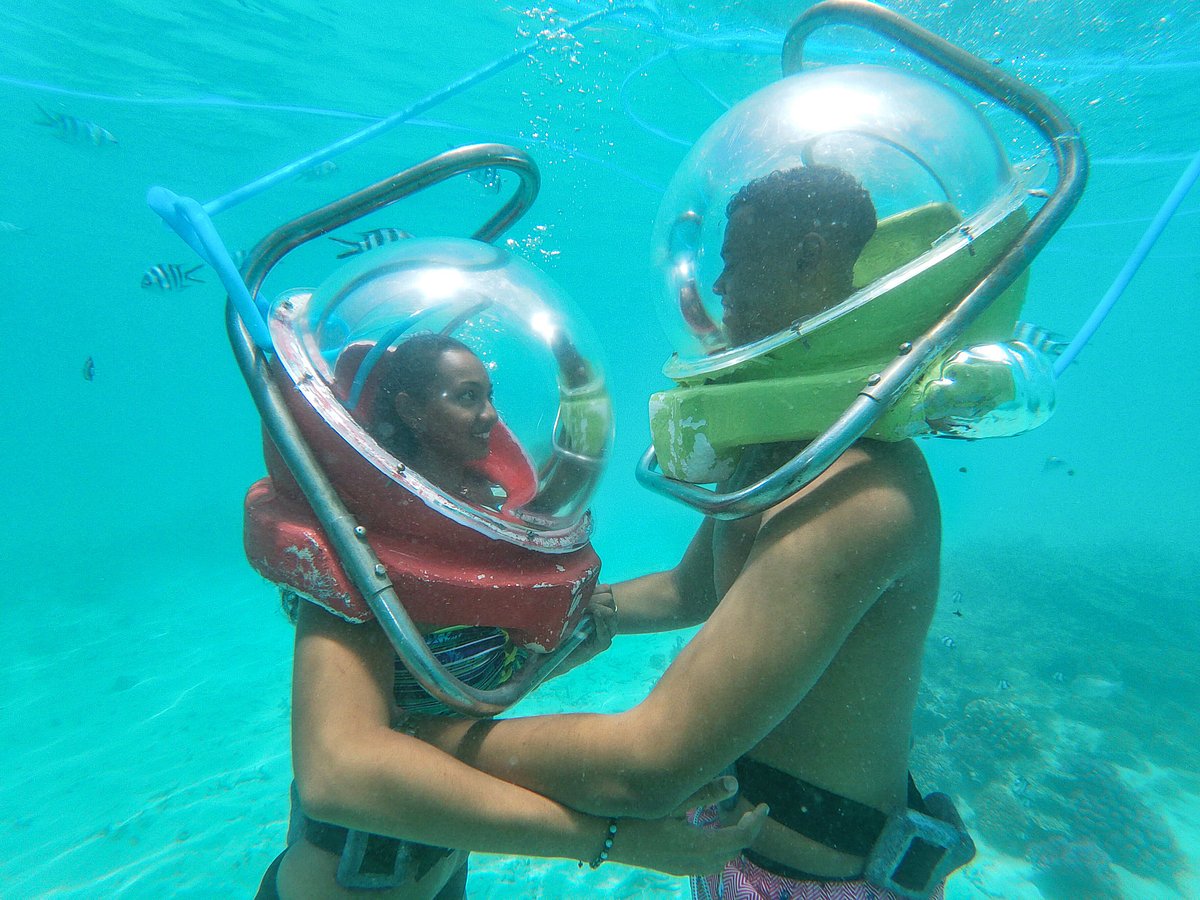
Belle Mare sea walk operations use surface-supplied air helmets that rest on your shoulders, allowing you to breathe normally while walking a marked seabed route at depths between 3 and 4 meters. The experience differs from scuba diving in that you remain upright, never fully submerge your head in the traditional sense, and require no prior training. Sessions typically last 20–25 minutes underwater after a safety briefing and boat transfer to the dive platform.
The Belle Mare coastline offers some of Mauritius's clearest lagoon water, a fact that operators of undersea walking experiences depend on entirely. Visibility determines whether participants can see the coral formations and reef fish that justify the activity, and the eastern lagoon's consistent clarity—ranging from 10 to 20 meters on calm days—makes it the island's most reliable location for helmet diving. Two distinct formats operate under the broad label of sea walking. The helmet dive, the dominant model here, uses a weighted helmet connected by hose to a surface compressor. You descend a ladder from a floating platform, walk a guide rope on the seabed, and interact with marine life while breathing surface air. The system requires no swimming ability and accommodates non-swimmers, though you must be comfortable with your head enclosed and able to equalize ear pressure. A less common variant, the underwater scooter walk, combines a helmet with a motorized platform, but Belle Mare operators focus almost exclusively on the traditional tethered walk due to the lagoon's compact dive zones and the fact that stationary walking allows closer fish interaction. Safety protocols here are more rigid than the average water sport. Each participant undergoes a surface breathing test with the helmet before descending. Guides monitor air supply continuously, maintain physical contact with participants who signal discomfort, and abort dives immediately if visibility drops below operational minimums. The maximum ratio is four participants per guide. Medical restrictions are enforced: pregnancy, severe sinus conditions, recent surgeries, and heart conditions disqualify participants outright. Age limits sit at 10 years minimum due to helmet weight and the need to equalize pressure independently. Water temperature and current strength fluctuate seasonally. November through April brings warmer water—26 to 29°C—but also higher plankton levels that can reduce visibility. May through October offers cooler, clearer water, though southeast trade winds occasionally stir sediment in shallow zones. Operators adjust dive sites daily based on real-time lagoon conditions, sometimes relocating platforms mid-week when swells affect the primary site. The reef structure itself remains stable year-round; what changes is your ability to see it clearly and the density of fish schools, which peaks during the calmer winter months when baitfish congregate in the lagoon.
“Visibility determines whether participants can see the coral formations and reef fish that justify the activity, and the eastern lagoon's consistent clarity makes it the island's most reliable location for helmet diving.”
Optimal Timing for Your Belle Mare Sea Walk
The best arrival window for the Belle Mare sea walk is 08:30–10:30. Early morning hours are critical for this activity as they typically offer calmer sea conditions and superior underwater visibility.
Summer (Nov–Apr)
Moderate to high25°C–31°C. Warm water, higher humidity.
Higher temperatures and calmer seas favor morning walks before afternoon breezes rise.
Winter (May–Oct)
Lower to moderate19°C–25°C. Cool, dry, breezy.
Conditions remain clear, though morning sessions are advised to avoid cooler afternoon water temperatures.
Morning sessions
Minimal—
Arriving at 08:30 ensures the best water clarity and stable conditions for the guided walk.
Verdict: For the clearest water and most stable conditions, plan your visit for an early arrival between 08:30 and 10:30 during the months of April or October.
Weekly Operating Hours for Belle Mare Sea Walk
The Belle Mare Sea Walk operates on a consistent daily schedule throughout the week. Visitors may access the facility from morning through mid-afternoon.
| Monday | 08:30–16:30 | |
|---|---|---|
| Tuesday | 08:30–16:30 | |
| Wednesday | 08:30–16:30 | |
| Thursday | 08:30–16:30 | |
| Friday | 08:30–16:30 | |
| Saturday | 08:30–16:30 | |
| Sunday | 08:30–16:30 |
Safety Protocols and Conduct for Belle Mare Sea Walk
Underwater walking requires strict adherence to safety protocols and respectful conduct toward marine life. Following these guidelines ensures both your safety and the preservation of Belle Mare's coral ecosystem.
Do
- Listen carefully to your guide's pre-descent safety briefing
- Equalize ear pressure gently during descent and ascent
- Move slowly and deliberately to conserve air and energy
- Signal your guide immediately if you experience discomfort
- Stay within designated walking zones to protect coral formations
- Maintain the breathing rhythm demonstrated during your briefing
Don't
- Touch or disturb coral formations or marine creatures
- Remove your helmet or tamper with equipment underwater
- Wander away from your group or assigned guide
- Participate if you have ear infections or respiratory conditions
- Hold your breath or breathe irregularly while submerged
- Feed fish or interfere with natural marine behavior
Directions to the Belle Mare Sea Walk Site
The Belle Mare Sea Walk is located along the Coastal Road in Belle Mare, Mauritius. Reaching the site is most efficiently achieved by private vehicle or taxi, which allows for direct access to the coastal activity centers.
Follow the Coastal Road (B60) towards Belle Mare; parking is available near the beach access points.
Request a drop-off at the Coastal Road in Belle Mare near the designated activity zone.
Take a local bus to the Belle Mare bus terminal and complete the journey to the Coastal Road via taxi or on foot.
Check availability
Frequently Asked Questions About Belle Mare Sea Walk
Everything you need to know about belle mare sea walk